EN
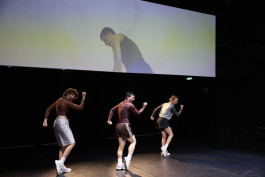
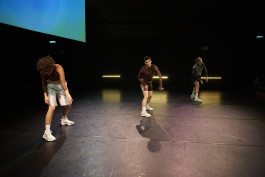
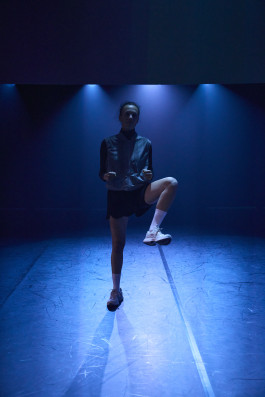
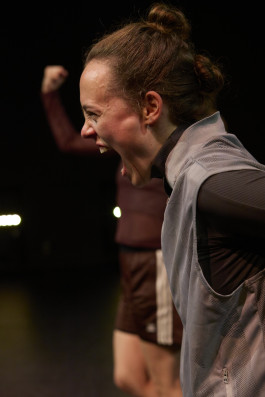
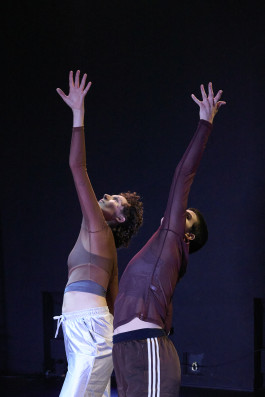
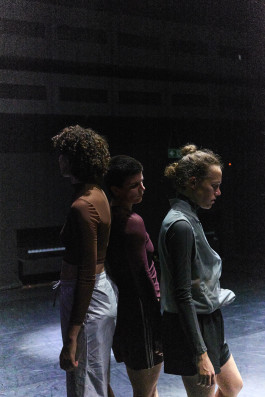
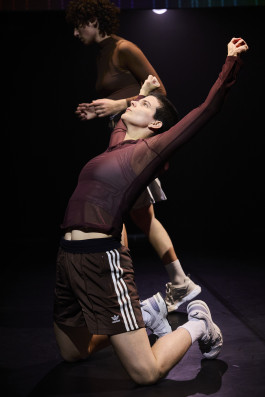
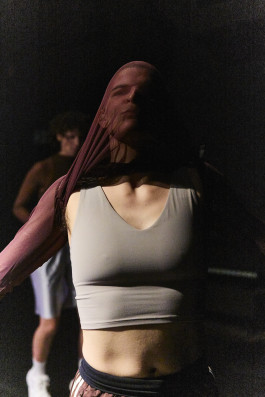
Tears and Squats for Cicero, examines the political dimensions of emotion, bodily representation, and media staging in sport and explores the body as a site of political representation and identity negotiation. The starting point is an engagement with Leni Riefenstahl’s Olympia films (Fest der Völker, Fest der Schönheit, 1936), whose visual language glorified athletic bodies and served as propaganda for National Socialism. Building on this, the performance traces a line from ancient ideals of the body through fascist image politics to the present-day mediation of large-scale sporting events via social media and AI. The piece explores how emotions in sport are not simply expressions of personal experience, but are shaped, structured, and loaded with meaning through deliberate dramaturgical strategies. In a hybrid composition of dance, video projection, and AI-generated imagery, a performative analysis emerges - focusing on representations of bodies, collective formations, and emotional dynamics in sport. With three dancers and large-scale projections, a choreographic space unfolds where movement, affect, and image production intersect. Using choreographic reenactment, embodiment, glitch, and algorithmically generated images, the work reflects on body politics, emotional dramaturgy, and media representation in the context of sport.
DE
Tears and Squats for Cicero, analysiert die politische Dimension von Emotion, Körperdarstellung und medialer Inszenierung im Sport. Ausgangspunkt ist die Auseinandersetzung mit Leni Riefenstahls Olympia-Filmen (Fest der Völker, Fest der Schönheit, 1936), deren Bildsprache sportliche Körper verherrlicht und zu nationalsozialistischen Propagandazwecken instrumentalisiert. Davon ausgehend spannt die Performance einen Bogen von antiken Körper-Idealen über faschistische Bildpolitiken des Sports bis zur medialen Aufladung von Sportgroßveranstaltungen und deren Verwertung durch Social Media und KI in der Gegenwart.
Dabei untersucht das Stück, wie Emotionen im Sport nicht (nur) Ausdruck individueller Erfahrung sind, sondern durch bewusste Dramaturgien geformt, gerahmt und mit Bedeutung aufgeladen werden. In einem hybriden Zusammenspiel aus Tanz, Videoprojektion und KI-generiertem Bildmaterial entsteht eine performative Analyse von Körper-, Menschen- und Gefühlsbildern im Sport. Mit drei Tänzer*innen und einer großflächigen Projektion wird ein choreografischer Raum entworfen, in dem Bewegung, Affekt und Bildproduktion ineinandergreifen. Durch tänzerisches Reenactment, Embodiment, Glitch und algorithmisch erzeugte Bilder entsteht eine Reflexion über Körperpolitiken, Emotionsdramaturgien und mediale Repräsentation im Sport.
Konzept und Choreografie: Nicola Kötterl
Tanz und choreographische Zusammenarbeit: Eléonore Barbara Bovet, Ida Schönamsgruber, Leonie Stöckle
Videoregie: Nicola Kötterl mit Sofian Biazzi und Nicolas Maximilian Sofian Biazzi
Video-Visuals: Sofiyan Biazzi
Kamera: Nicolas Maximilian
Sound: Fabiola Wörter
Dramaturgische Beratung: Manon Haase
Produktion: Lara Schubert
Licht: Benjamin Schmidt
Presse: Peter Sampel
Grafik: Naho Matsuda
Funded by:


EN
Tears and Squats for Cicero, examines the political dimensions of emotion, bodily representation, and media staging in sport and explores the body as a site of political representation and identity negotiation. The starting point is an engagement with Leni Riefenstahl’s Olympia films (Fest der Völker, Fest der Schönheit, 1936), whose visual language glorified athletic bodies and served as propaganda for National Socialism. Building on this, the performance traces a line from ancient ideals of the body through fascist image politics to the present-day mediation of large-scale sporting events via social media and AI. The piece explores how emotions in sport are not simply expressions of personal experience, but are shaped, structured, and loaded with meaning through deliberate dramaturgical strategies. In a hybrid composition of dance, video projection, and AI-generated imagery, a performative analysis emerges - focusing on representations of bodies, collective formations, and emotional dynamics in sport. With three dancers and large-scale projections, a choreographic space unfolds where movement, affect, and image production intersect. Using choreographic reenactment, embodiment, glitch, and algorithmically generated images, the work reflects on body politics, emotional dramaturgy, and media representation in the context of sport.
DE
Tears and Squats for Cicero, analysiert die politische Dimension von Emotion, Körperdarstellung und medialer Inszenierung im Sport. Ausgangspunkt ist die Auseinandersetzung mit Leni Riefenstahls Olympia-Filmen (Fest der Völker, Fest der Schönheit, 1936), deren Bildsprache sportliche Körper verherrlicht und zu nationalsozialistischen Propagandazwecken instrumentalisiert. Davon ausgehend spannt die Performance einen Bogen von antiken Körper-Idealen über faschistische Bildpolitiken des Sports bis zur medialen Aufladung von Sportgroßveranstaltungen und deren Verwertung durch Social Media und KI in der Gegenwart.
Dabei untersucht das Stück, wie Emotionen im Sport nicht (nur) Ausdruck individueller Erfahrung sind, sondern durch bewusste Dramaturgien geformt, gerahmt und mit Bedeutung aufgeladen werden. In einem hybriden Zusammenspiel aus Tanz, Videoprojektion und KI-generiertem Bildmaterial entsteht eine performative Analyse von Körper-, Menschen- und Gefühlsbildern im Sport. Mit drei Tänzer*innen und einer großflächigen Projektion wird ein choreografischer Raum entworfen, in dem Bewegung, Affekt und Bildproduktion ineinandergreifen. Durch tänzerisches Reenactment, Embodiment, Glitch und algorithmisch erzeugte Bilder entsteht eine Reflexion über Körperpolitiken, Emotionsdramaturgien und mediale Repräsentation im Sport.
Konzept und Choreografie: Nicola Kötterl
Tanz und choreographische Zusammenarbeit: Eléonore Barbara Bovet, Ida Schönamsgruber, Leonie Stöckle
Videoregie: Nicola Kötterl mit Sofian Biazzi und Nicolas Maximilian Sofian Biazzi
Video-Visuals: Sofiyan Biazzi
Kamera: Nicolas Maximilian
Sound: Fabiola Wörter
Dramaturgische Beratung: Manon Haase
Produktion: Lara Schubert
Licht: Benjamin Schmidt
Presse: Peter Sampel
Grafik: Naho Matsuda
Funded by: